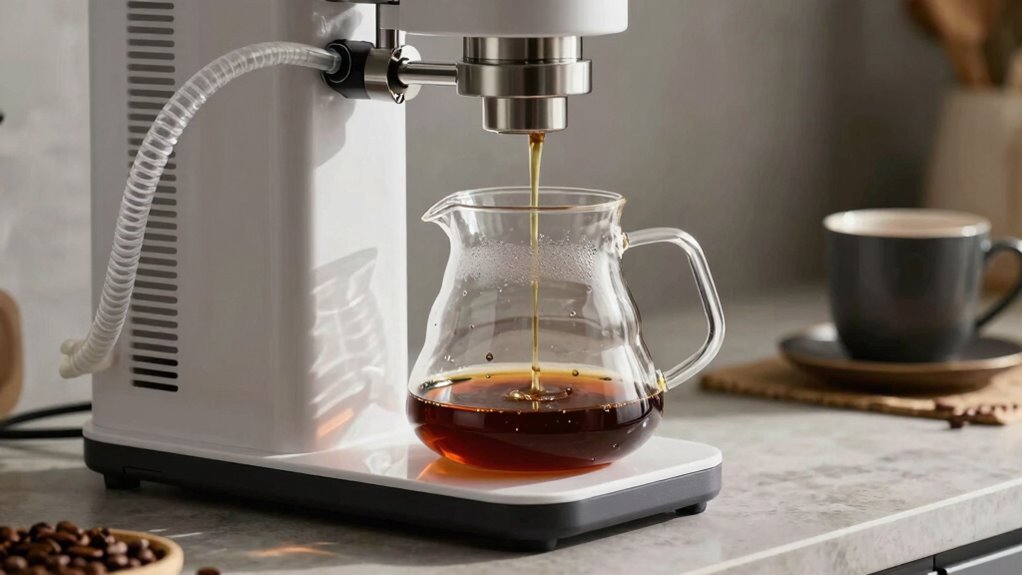

Using reverse osmosis for coffee gives you great control over water purity, removing impurities and contaminants that can muddy flavors. However, it can also strip away essential minerals like calcium and magnesium, which are key to developing complexity and richness in your brew. Without these minerals, your coffee might taste flat or dull. If you want to learn how to balance water quality for the best flavor, keep exploring the important factors involved.

Get coffee and tea gear delivered free — and shop member deals
- Fast, free delivery on millions of items
- Access to Prime Big Deal Days deals on October 6–7
- Prime Video, Amazon Music and more included
Key Takeaways
- Reverse osmosis produces highly pure water, removing impurities but also stripping beneficial minerals essential for flavor.
- Proper mineral reintroduction after RO is necessary to enhance coffee’s flavor complexity and extraction.
- RO water can result in flat-tasting coffee unless minerals are added back to balance taste.
- Using RO allows precise control over water quality but requires additional effort to optimize mineral content.
- The decision depends on initial water quality and whether mineral adjustments are made post-RO for desired flavor profiles.

If you’re serious about brewing the perfect cup of coffee, understanding how reverse osmosis can improve your water quality is crucial. Reverse osmosis (RO) is a filtration process that removes impurities, contaminants, and dissolved solids from water, giving you a much clearer base for brewing. But whether it’s helpful or too extreme depends on how you use it and your desired coffee profile. One key aspect to contemplate is water mineralization. Coffee relies heavily on mineral content in water to develop its flavor profile. When you use pure RO water, most minerals—like calcium, magnesium, and sodium—are stripped away, leaving water that’s almost flat in taste. This can make your coffee taste dull or underwhelming because minerals contribute to the extraction process, influencing how flavors are released from the beans.
Pure reverse osmosis water can dull coffee flavor by removing essential minerals needed for optimal extraction.
On the other hand, removing excess impurities can lead to a more controlled brewing process. If your tap water is heavily chlorinated or contains high levels of undesirable elements, RO can eliminate these issues, resulting in a cleaner, more consistent brew. However, because pure RO water lacks minerals, it can also cause your coffee to taste overly flat or dull if you don’t adjust your mineral content afterward. Many baristas and enthusiasts add back specific minerals to enhance brewing flavor, tailoring the water to bring out the best in their beans. This practice allows you to strike a balance—benefiting from the purity of reverse osmosis while boosting water mineralization to maximize flavor extraction.
Some consider RO too extreme for coffee brewing because it can strip away the very minerals that enrich the flavor. Coffee’s complexity relies on a delicate interplay of water and bean chemistry, and mineral content plays a significant role. Without minerals, the extraction process may be less efficient, and the resulting cup might lack depth. For those who prefer a more nuanced flavor profile, using RO water alone might be limiting unless you’re willing to add back minerals intentionally. Additionally, understanding how water mineralization impacts flavor can help you make more informed choices about your brewing process. Moreover, recognizing the impact of minerals on extraction can help you fine-tune your water for optimal flavor development.
Furthermore, understanding how water source variability influences mineral content can guide you in choosing whether RO is necessary for your specific water quality. Knowing the quality of your tap water can help determine if RO treatment is worth the effort or if adjustments are needed. Ultimately, whether reverse osmosis is helpful or too extreme depends on your aims. If you want absolute control over your water quality and don’t mind tweaking mineral levels, RO can be a powerful tool. But if you prefer a more hands-off approach, it might require extra effort to get the water just right for maximizing brewing flavor. In the end, understanding how to balance water mineralization with reverse osmosis ensures you can craft the coffee you love, with clarity and richness in every cup.
reverse osmosis water filter for coffee
As an affiliate, we earn on qualifying purchases.
As an affiliate, we earn on qualifying purchases.
Frequently Asked Questions
Can Reverse Osmosis Improve Coffee Flavor Significantly?
Yes, reverse osmosis can considerably improve your coffee flavor by removing impurities and excess minerals. The process enhances flavor clarity and highlights subtle taste notes, giving you a cleaner cup. By removing unwanted minerals, it also prevents mineral buildup in your equipment. However, keep in mind that some minerals are beneficial for flavor, so you might need to re-mineralize your water for the best balance and overall coffee experience.
Is Reverse Osmosis Cost-Effective for Home Coffee Brewing?
Yes, reverse osmosis can be cost-effective for home coffee brewing if you value precise mineral content and water pH control. It removes impurities, helping improve flavor clarity, but the initial setup and filter replacements add to costs. Over time, you might save on specialty waters or flavor adjustments. Consider your taste preferences and budget—if you want consistent quality and are okay with maintenance, it’s a worthwhile investment.
Does RO Water Affect Coffee Bean Extraction?
Yes, RO water affects coffee bean extraction because its low mineralization impacts flavor and extraction efficiency. Without minerals, water struggles to dissolve coffee compounds, leading to flat or dull taste. To optimize extraction, you should consider adjusting brewing temperature and re-mineralizing the water. Proper mineralization enhances flavor, and controlling brewing temperature ensures proper extraction, making your coffee more balanced and flavorful even with RO water.
How Often Should RO Filters Be Replaced for Coffee Use?
For ideal coffee, replace your RO filters regularly—every 6 to 12 months, depending on water mineralization levels. As filters age, their efficiency declines, diminishing filter lifespan and water quality. Consistently monitoring water mineralization helps you determine when to switch; less mineral buildup means longer-lasting filters. Prioritize prompt replacements to preserve pure water, ensuring perfect extraction and a robust, refined coffee experience.
Are There Any Health Risks Using RO Water in Coffee?
Using RO water in coffee generally doesn’t pose health risks because it’s ultra-pure, with minimal mineral content and balanced pH. However, since RO removes minerals essential for flavor and health, you might notice a flat taste or reduced mineral intake. If you brew coffee with RO water regularly, consider adding back some minerals or using mineral-enhanced water to maintain ideal pH balance and enhance flavor.
coffee mineral reconstitution drops
As an affiliate, we earn on qualifying purchases.
As an affiliate, we earn on qualifying purchases.
Conclusion
Just like the legendary alchemists sought to transform base metals into gold, you might wonder if reverse osmosis can elevate your coffee to perfection. While it offers remarkable control over water quality, it’s not a one-size-fits-all solution, and sometimes, simplicity is key. Remember, even the greatest brewers know that purity is important, but so is balance. So, weigh the extremes carefully—sometimes, the best coffee lies in the harmony between innovation and tradition.
As an affiliate, we earn on qualifying purchases.
RO water filtration system for brewing
As an affiliate, we earn on qualifying purchases.
As an affiliate, we earn on qualifying purchases.
Fall Picks
fall essentials
As an affiliate, we earn on qualifying purchases.