
You need fewer fine particles in filter coffee because they can clog the filter and disrupt water flow, leading to uneven extraction. Too many fines cause the brew to become over-extracted, resulting in bitterness and a dull taste. A coarser grind helps water move smoothly through the grounds, producing a cleaner, balanced flavor. If you want to learn how to optimize your brew by controlling particle size, there’s more to discover ahead.

Get coffee and tea gear delivered free — and shop member deals
- Fast, free delivery on millions of items
- Access to Prime Big Deal Days deals on October 6–7
- Prime Video, Amazon Music and more included
Key Takeaways
- Fine particles can clog filters, leading to slow water flow and inconsistent brewing.
- Excess fine particles cause over-extraction, resulting in bitter and dull flavors.
- A higher concentration of fine particles can produce muddy, cloudy cups.
- Fewer fine particles promote even extraction and a cleaner, more nuanced flavor profile.
- Coarser grind size ensures smoother water passage and better aroma preservation.
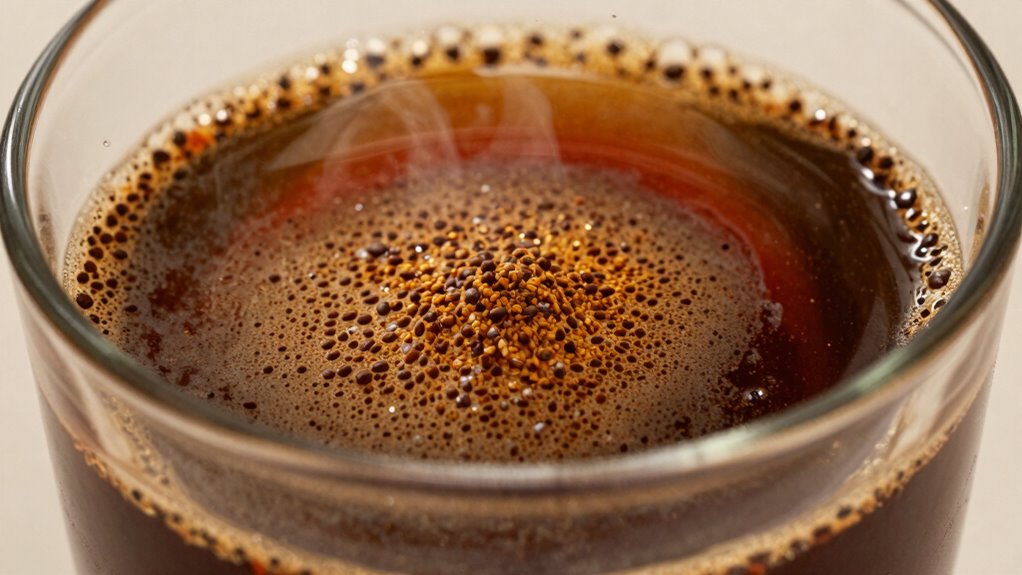
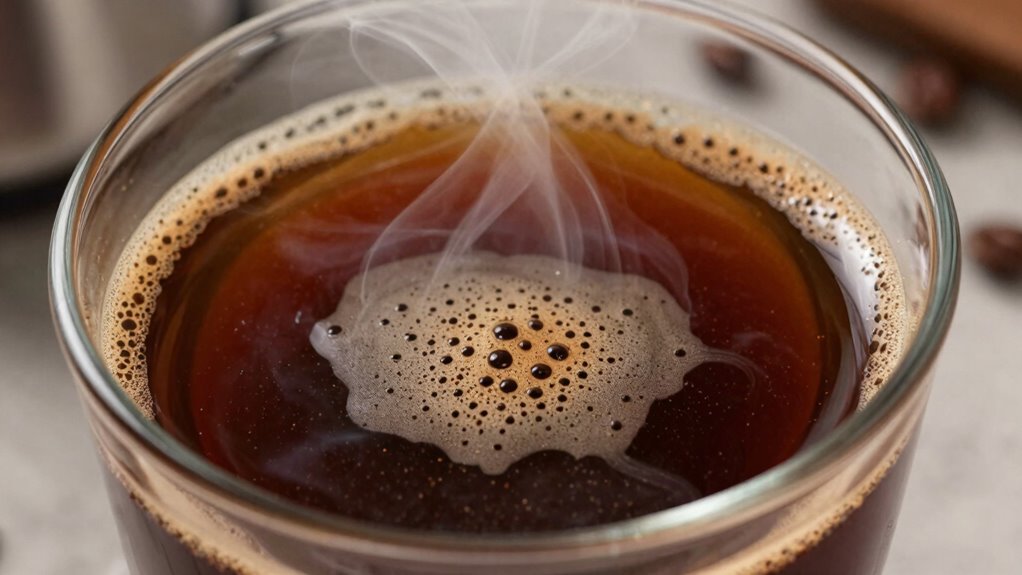
Ever wondered what makes filter coffee so rich and flavorful? It all comes down to the delicate balance of factors like brewing temperature and grind size, especially when it comes to the size of the coffee particles. Unlike espresso or Turkish coffee, filter coffee thrives on a specific particle size that allows water to flow through smoothly without extracting unwanted bitter compounds. When you use too many fine particles, the brewing process can get disrupted, leading to over-extraction and a muddy, overly bitter cup.
The key to a great filter coffee lies in controlling the grind size. You want a consistency that’s somewhat coarser than table salt but finer than what you’d use for French press. When your grind is too fine, tiny particles tend to clog the filter paper or mesh, causing water to slow down or even back up. This results in uneven extraction, where some particles release their flavors too quickly while others remain under-extracted. As a result, your coffee might taste overly bitter or overly weak. To prevent this, you should aim for fewer fine particles by adjusting the grind size to be slightly coarser. This guarantees the water flows at a suitable rate, extracting a balanced spectrum of flavors without becoming bitter or dull.
Brewing temperature also plays a crucial role here. Ideally, you want your water to be between 195°F and 205°F, hot enough to extract the flavors efficiently but not so hot that it over-extracts delicate compounds. When the temperature is just right, it complements the grind size by facilitating an even extraction process. If the temperature is too high, finer particles become problematic because they tend to release bitter compounds quickly. Conversely, if it’s too low, the coffee may remain under-extracted, leaving it flat and lacking in flavor. Maintaining proper temperature control is essential for achieving a balanced brew. When you combine the right brewing temperature with a coarser grind, you create the perfect environment for fewer fine particles, resulting in a cleaner, more nuanced cup. Properly managing these variables can also help optimize the extraction process to bring out the best in your coffee.
Controlling particle size and temperature helps maintain the proper flow rate and extraction, crucial for a well-balanced brew. In essence, the reason filter coffee needs fewer fine particles is because smaller particles tend to clog filters and cause uneven extraction, negatively affecting flavor. By adjusting your grind size to be coarser and maintaining an appropriate brewing temperature, you guarantee a smooth flow of water and a balanced extraction. This harmony between particle size and temperature allows you to enjoy the full spectrum of flavors in your brew, highlighting the rich aromas and smooth textures that make filter coffee so beloved. So, next time you brew, pay attention to these details—they’re the secret to a perfect cup.
coffee grinder for filter coffee
As an affiliate, we earn on qualifying purchases.
As an affiliate, we earn on qualifying purchases.
Frequently Asked Questions
How Do Particle Sizes Affect Coffee Brewing Time?
Particle sizes greatly influence brewing time because finer particles increase surface area, making extraction quicker, while coarser ones slow it down. With a consistent grind, you control extraction and flavor. Finer particles tend to settle faster, potentially leading to over-extraction, whereas coarser particles allow for a longer brew time, ensuring balanced flavor. Proper grind consistency helps manage particle settling, resulting in a more controlled and ideal brewing process.
Can Filtering Remove All Fine Particles From Coffee?
Filtering can considerably reduce, but not completely eliminate, fine particles like coffee sediment. You might still find tiny remnants floating or settling, affecting brewing consistency. While a good filter traps many fine particles, some microscopic bits slip through, impacting the clarity and smoothness of your cup. Thus, for the purest pour, you’ll want to select filters that target finer particles to guarantee your coffee remains clean and consistent.
What Equipment Best Controls Particle Size in Brewing?
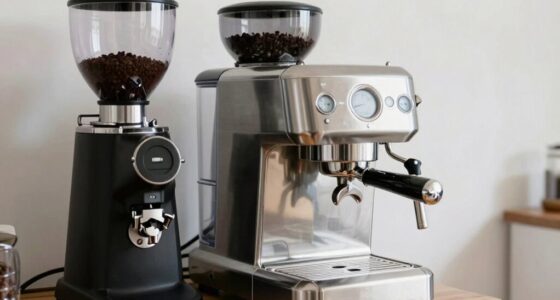
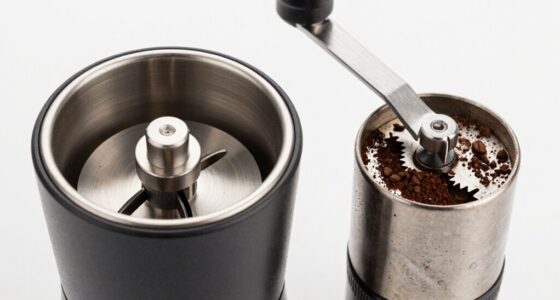
You should use a burr grinder to control particle size precisely, ensuring consistent grinding consistency. This consistency helps improve filter efficiency by producing uniform particles that allow water to flow evenly through the coffee grounds. Avoid blade grinders, which create uneven particles, leading to over-extraction or under-extraction. By maintaining uniform particle size, you get a cleaner, more balanced brew and better overall control over your filter coffee.
Do Different Coffee Beans Produce Varying Particle Sizes?
Yes, different coffee beans produce varying particle sizes. The origin of the coffee bean influences its density and structure, affecting how it breaks down during grinding. Additionally, the roasting level impacts the bean’s brittleness; darker roasts tend to produce finer particles, while lighter roasts yield coarser grounds. You’ll notice these differences when adjusting your grind size to optimize extraction and flavor, depending on the bean’s origin and roast.
How Does Particle Size Influence Coffee’s Flavor Profile?
Imagine a tiny universe inside your cup, where particle size orchestrates flavor extraction. When particles are too fine, they release intense flavors quickly, overwhelming your senses. Larger particles slow down extraction, revealing nuanced aromas and smoother textures. Your sensory perception shifts, revealing complex layers. So, controlling particle size shapes your coffee’s flavor profile—making each sip a carefully crafted journey of taste, aroma, and satisfaction.
As an affiliate, we earn on qualifying purchases.
Conclusion
By choosing a filter with fewer fine particles, you guarantee a smoother, more balanced cup of coffee. For example, imagine Sarah switching to a coarser grind after noticing her brew was overly bitter and gritty. She found her coffee became richer and less harsh, highlighting how fewer fine particles can enhance flavor. So, next time you brew, consider adjusting your grind size—your taste buds will thank you for the cleaner, more enjoyable coffee experience.
temperature-controlled coffee kettle
As an affiliate, we earn on qualifying purchases.
As an affiliate, we earn on qualifying purchases.
As an affiliate, we earn on qualifying purchases.
Fall Picks
fall essentials
As an affiliate, we earn on qualifying purchases.