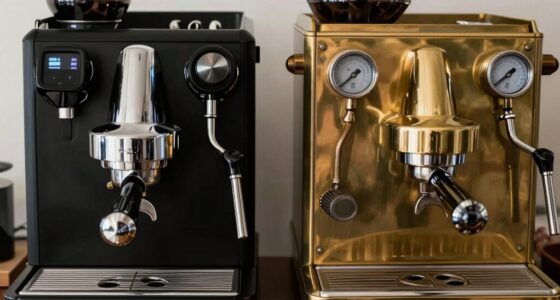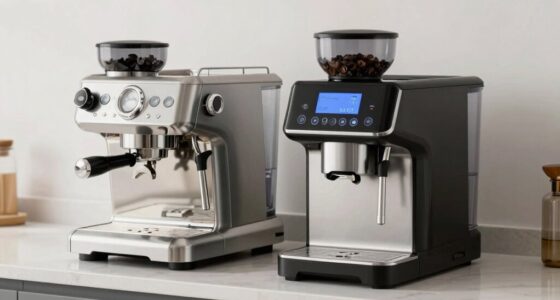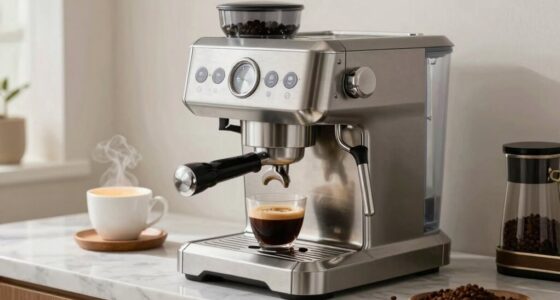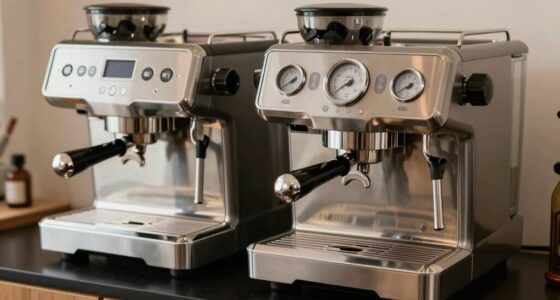
If you prioritize speed and efficiency in a busy setup, a dual boiler machine is ideal since it allows you to brew and steam simultaneously, ensuring consistent temperatures. If you’re new to espresso or have limited space, a heat exchange machine might suit you better, offering simpler operation and quicker shifts. Your workflow needs, experience level, and space will influence the best choice for you. Keep exploring to discover which system truly matches your coffee routine.
Key Takeaways
- Dual boilers support simultaneous brewing and steaming, ideal for busy, multi-shot workflows.
- Heat exchange machines are suitable for simpler, quicker routines with brief mode switching.
- Workflow efficiency depends on the number of shots and steaming needs; dual boilers excel in high-volume settings.
- Heat exchange models offer faster operation with less complexity, fitting casual or beginner use.
- Proper temperature management is crucial in heat exchange systems to maintain consistent workflow quality.
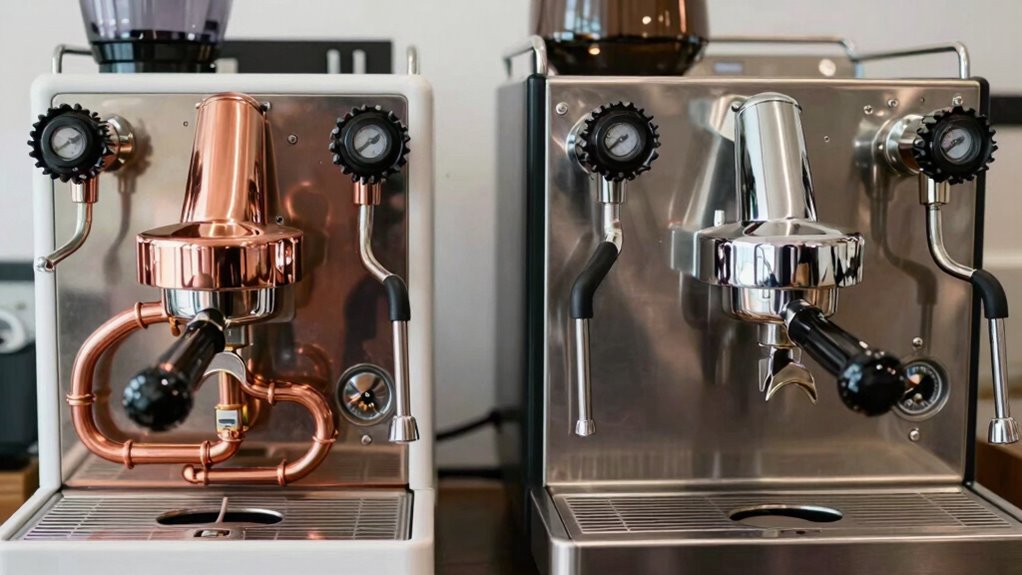
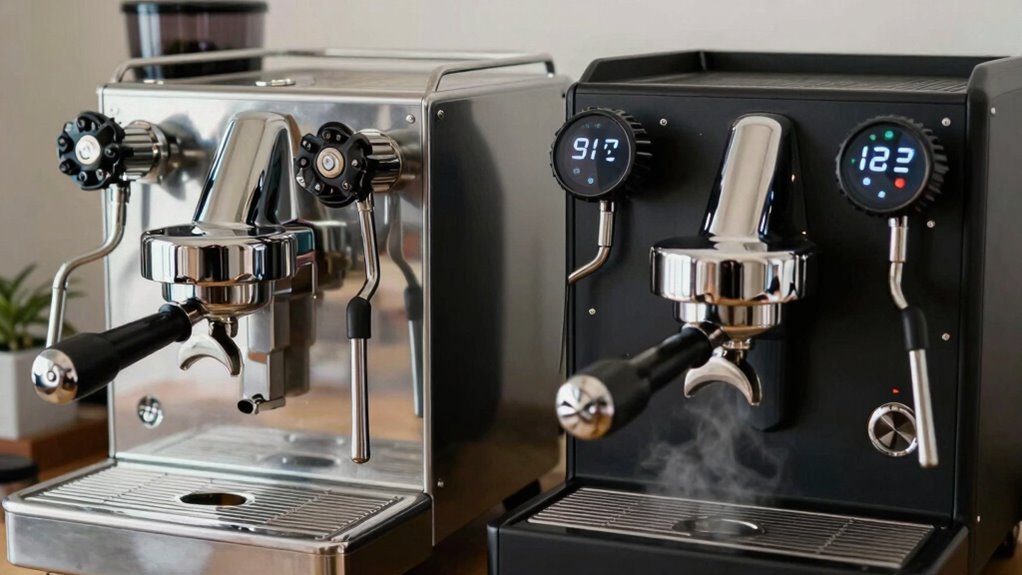
Are you trying to choose between a heat exchange and a dual boiler espresso machine? Both options have their advantages, but understanding how they affect your workflow can help you make the right choice. When it comes to coffee extraction, the way your machine manages temperature stability is crucial. A dual boiler machine heats water in two separate chambers—one for brewing and one for steaming—which allows you to maintain consistent temperatures for each process. This consistency results in superior coffee extraction, giving you a richer, more balanced shot every time. On the other hand, a heat exchange machine uses a single boiler with a copper pipe or a similar system to transfer heat efficiently. It’s designed to quickly switch between brewing and steaming modes, making it suitable for a faster workflow. However, because it shares the boiler for both functions, temperature fluctuations can occur, potentially impacting the quality of your coffee extraction if not carefully managed. Proper temperature stability is essential for achieving optimal results in espresso brewing. Your choice also hinges on how much time you want to spend on machine maintenance. Dual boiler machines tend to be more complex, with additional components and more rigorous cleaning routines. They require regular descaling and careful upkeep to keep both boilers functioning optimally, but their durability often pays off with consistent performance over time. Additionally, the initial investment for dual boiler machines is typically higher, which can influence your decision based on budget constraints. Workflow efficiency is another factor to consider. If you’re making multiple espresso shots and steaming milk frequently, a dual boiler might be your best option. It allows you to do both simultaneously without waiting, speeding up your process significantly. With a heat exchange machine, you need to pause briefly when switching between brewing and steaming, which might slow you down during busy periods. Nonetheless, heat exchange models often come at a lower price point and take up less space, making them ideal for smaller setups or home baristas who want good performance without the complexity. Furthermore, ease of use can be an important aspect for those new to espresso machines. When considering the maintenance routines, it’s important to note that both systems can produce excellent coffee, but aligning their features with your routine ensures your espresso experience is smooth and satisfying. A machine with temperature control features can help mitigate fluctuations, especially in heat exchange models, leading to better results. Ultimately, your choice depends on your priorities: if you’re looking for top-tier coffee extraction with minimal temperature fluctuation and don’t mind extra maintenance, a dual boiler machine fits best. If you prefer a faster, more straightforward workflow with easier upkeep and a smaller footprint, a heat exchange machine might be the better fit.
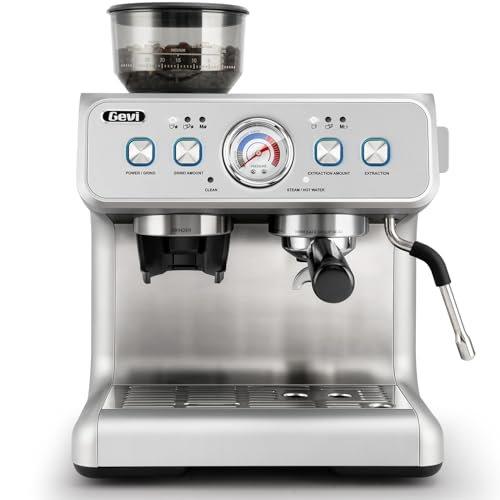
Gevi Dual Boiler Espresso Machine with Built-in Grinder, 58mm Commercial Portafilter, Barista Steam Wand, 31 Grind Settings, Stainless Steel, for Home Barista Use, Sterling Silver
𝐏𝐨𝐰𝐞𝐫𝐟𝐮𝐥 𝐚𝐧𝐝 𝐬𝐭𝐚𝐛𝐥𝐞 𝐏𝐫𝐞𝐬𝐬𝐮𝐫𝐞 𝐒𝐲𝐬𝐭𝐞𝐦 – Gevi espresso machine's high-pressure system expertly manages the flow of water, forcing…
As an affiliate, we earn on qualifying purchases.
As an affiliate, we earn on qualifying purchases.
Frequently Asked Questions
Which Machine Is Easier for Beginners to Operate?
You’ll find the heat exchange machine easier to operate as a beginner because of its simpler design, which reduces machine complexity. Its straightforward process requires less user familiarity with advanced settings, making it more intuitive. The dual boiler offers more control but involves more steps, which can be overwhelming for newcomers. So, if you’re just starting out, a heat exchange machine helps you learn brewing basics without added complexity.
How Does Maintenance Differ Between Heat Exchange and Dual Boiler Machines?
You’ll find that maintenance on heat exchange machines generally involves simpler cleaning, focusing on the brew group and water circuits, which helps prolong machine longevity. Dual boiler machines require more frequent and thorough cleaning of two boilers, demanding extra time but offering consistent performance. Overall, heat exchange models often have lower cleaning requirements, making them easier to maintain for longer periods, while dual boilers demand more diligent upkeep to guarantee ideal operation.
Can Both Systems Produce Consistent Espresso Shots Over Time?
You can expect both systems to produce consistent espresso shots over time, thanks to their design. Heat exchange machines often maintain temperature stability well, while dual boiler setups excel at shot consistency because they independently control brew and steam temperatures. Notably, studies show dual boilers can maintain temperature stability within 1°C, ensuring you get reliable results shot after shot. Your choice depends on your priority for shot consistency or temperature control.
Which Workflow Is More Energy-Efficient?
The heat exchange system generally uses less energy because it heats water on demand, reducing overall energy consumption. The dual boiler requires more power, as it maintains separate boilers at ideal temperatures constantly. From an environmental impact perspective, the heat exchange setup is more eco-friendly due to its lower energy use. If you’re focused on conserving energy and reducing your carbon footprint, the heat exchange workflow is the better choice.
Are There Specific Coffee Beans Better Suited for Each System?
Think of your espresso machine as a fine-tuned orchestra; the right beans hit all the right notes. For heat exchange systems, medium roasts with balanced acidity and sweetness work best, enhancing flavor extraction. Dual boilers excel with a variety of beans, especially those needing precise temperature control like dark roasts or single-origin beans. Ultimately, select beans that match your flavor goals and machine capabilities for ideal results.

CASABREWS CM5418 Espresso Machine 20 Bar, Compact Espresso Maker with Steam Milk Frother, Stainless Steel Coffee Machine with 34oz Removable Water Tank for Cappuccino, Small Latte Machine, Silver
Make Your Favorite Espresso Coffee At Home: The CASABREWS coffee machine with milk frother allows you to prepare…
As an affiliate, we earn on qualifying purchases.
As an affiliate, we earn on qualifying purchases.
Conclusion
So, now you’re faced with the ultimate coffee conundrum: heat exchange or dual boiler? Whether you’re a speed demon craving quick pulls or a precision chaser who loves meticulous control, the choice is yours. Just remember, no matter what you pick, you’re still just trying to get that perfect shot—because at the end of the day, it’s not about the machine, it’s about your undying love for caffeine. Cheers to making the perfect brew!

Philips 3300 Series Fully Automatic Espresso Machine with integrated milk frother and grinder, 5 Hot & Iced Coffee Pre-Sets, 40% Quieter SilentBrew, 15-Bar Pressure, Glossy Black (EP3326/90)
5 PRESETS, ENDLESS COMBINATIONS: Espresso, coffee, espresso lungo, iced coffee, or simply hot water, take your pick. Top…
As an affiliate, we earn on qualifying purchases.
As an affiliate, we earn on qualifying purchases.

Y-Step 8 Pcs Espresso Accessories Kit, 51mm Espresso Tamper Kit Espresso Tools Barista Kit & Espresso Tamping Station, with 51mm Coffee Tamper, Distributor, WDT Tool, Dosing Funnel, Puck Screen, Brush
8-In-1 Espresso Machine Accessories Kit: This complete espresso tool kit includes everything you need to master the art…
As an affiliate, we earn on qualifying purchases.
As an affiliate, we earn on qualifying purchases.