
TL;DR

Get coffee and tea gear delivered free with Prime
- Fast, free delivery on millions of items
- Prime Video, Amazon Music and more included
- Member-only deals all year
Electric milk frothers whisk air into milk to make foam for drinks such as cappuccinos, lattes, and iced coffee; some models also heat milk. A handheld wand is inexpensive and compact, while a heated jug offers more settings and less hands-on work, so match the model to your drinks, milk, and cleanup habits.
A little whirl of milk can turn an ordinary coffee into a drink with a soft cap of foam, but not every frother does the same job. Some models simply whisk air into milk; others heat it too, and that difference shapes your whole morning routine.
This guide explains what electric milk frothers do, how wand and jug models compare, and why milk choice and temperature change the results. You’ll also get a practical buying checklist, troubleshooting advice, and safe cleaning tips—so you can pick a machine that earns its counter space rather than becoming another dusty gadget.
Think of a frother as a tiny texture tool, not a miniature espresso machine. It can add a creamy, airy finish to a home coffee, but it will not automatically reproduce the precise milk texture a trained barista creates with a steam wand. Knowing where it shines helps you spend wisely.
A handheld wand usually makes foam but does not heat milk; many jug-style models do both.
Dairy milk is a dependable starting point, while plant-based foam varies by brand; barista versions often work more consistently.
Start with cold milk for hot foam and avoid boiling it, which can hurt flavor and texture.
Compare capacity, cleaning instructions, storage, and settings before paying extra for features.
Rinse milk-contact parts promptly and keep water away from the powered base unless the manual says otherwise.
What an Electric Milk Frother Does for Your Coffee
Electric milk frothers spin a whisk or similar tool through milk, drawing air into it to create bubbles. How quickly those bubbles form, and how fine or stable they are, depends on the whisk, milk, and machine. Some models heat milk as they froth; others only change its texture. That distinction matters because a foamy topping and a full serving of warm milk are different jobs.
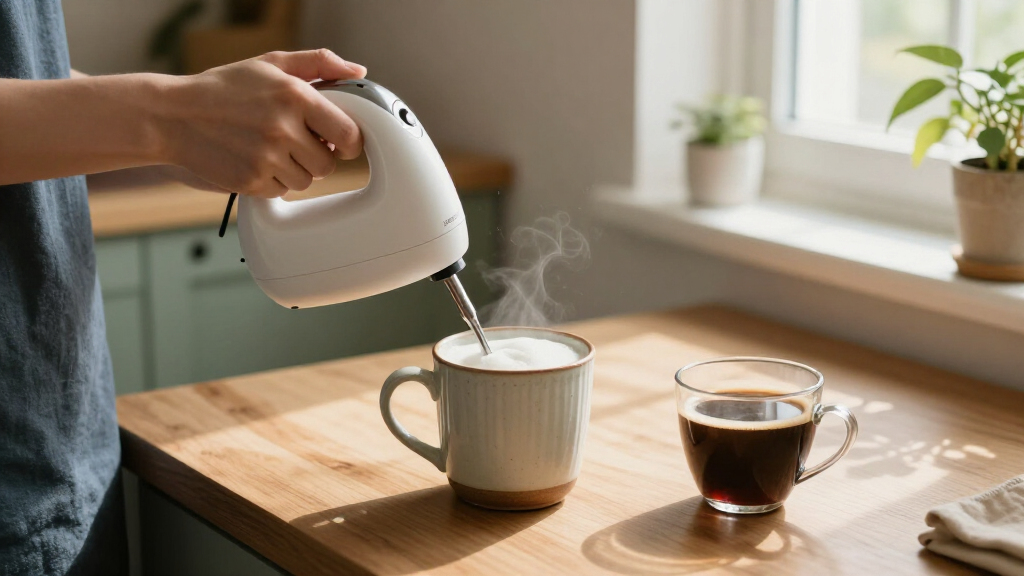
A handheld wand works like a tiny mixer: lower its spinning whisk into a cup, switch it on, and move it gently through the milk. It gives you control over where you whisk and is easy to store, but you have to heat milk separately if you want a hot drink. A jug-style machine contains the milk and usually handles heating and frothing together. That reduces hands-on work, though you need to respect its fill lines and clean the vessel after use.
For example, a few spoonfuls of wand-made foam can finish hot coffee quickly, but it will not warm a whole mug of milk for cocoa. A heated jug can do that more conveniently, provided its instructions allow the ingredients you plan to add. In either case, the frother makes foam for drinks; it does not brew coffee or replace an espresso machine. This helps set expectations: a frother changes milk, not the strength or extraction of the coffee underneath it.
The tradeoff is mainly control and convenience. A compact wand costs less and takes little space, but the separate heating step and manual whisking add small tasks to each drink. An automatic jug takes more counter space and usually costs more, yet it can combine those tasks in one cycle. If you make milk drinks often, that saved effort may matter more than extra settings; if you rarely use foam, the simplicity of a wand may be the better fit.
electric milk frother with heating
As an affiliate, we earn on qualifying purchases.
As an affiliate, we earn on qualifying purchases.
Choose the Frother Style That Fits Your Morning
Electric milk frothers fall into three main groups: handheld wands, heated jugs, and espresso-machine frothers. The best fit depends on whether you value low cost, one-touch heating, or more hands-on control. The practical question is not which type has the most features, but which one removes the steps you find inconvenient without adding storage or cleanup you will resent.
Use this comparison to picture an ordinary drink routine. If you make one small coffee before leaving home, a wand may be plenty because it is quick to retrieve and rinse. If you regularly prepare two hot drinks or cold foam for iced coffee, a jug with appropriate capacity and settings may save repeated work. Capacity is especially important for households: a jug that is too small may require multiple cycles, while a large one can take up more room and may not work well for a single small serving if the milk falls below its minimum fill level.
| Type | What it does | Best for | Tradeoff |
|---|---|---|---|
| Handheld whisk | Whisks milk in your cup; usually does not heat it | Occasional single servings and tight budgets | You heat milk separately and guide the whisk |
| Heated jug | Heats and froths milk; many models offer cold foam | Regular drinks and convenient one-touch operation | Uses counter space and needs jug cleanup |
| Espresso-machine frother | Uses a steam wand or automatic milk system | Espresso drinkers who want more control or integration | Can take practice; milk parts may need frequent cleaning |
Imagine you make a cappuccino most weekends but drink plain black coffee on weekdays. A small wand can cover that occasional need without giving up cabinet space. If you make a latte every morning, a jug’s automatic heating may be worth its extra cost and cleanup because you use its convenience every day. Frequency changes the calculation: a feature that feels unnecessary once a week can become valuable when it removes a repeated morning chore.
Check the actual manual and product specifications before buying. “Automatic” does not always mean dishwasher-safe, quiet, or suitable for every milk. A model’s minimum and maximum fill levels, whether its whisk detaches, and whether it can make both hot and cold foam all affect how easily it fits your routine. The right comparison includes capacity, settings, cleanup, noise, and durability, not just the number of buttons.
As an affiliate, we earn on qualifying purchases.
Get Better Foam by Matching Milk and Temperature
Milk foams when a whisk introduces air and components in the milk help keep the resulting bubbles from immediately collapsing. Protein content and the milk’s overall formulation affect that stability; temperature and frother design influence how the foam feels and holds. That is why two cartons can behave differently in the same machine, and why a powerful frother cannot always compensate for a milk that makes weak foam.
Whole milk often produces a richer-feeling foam, while lower-fat milk can feel lighter. Some oat, soy, and other plant-based milks froth well, especially versions labeled barista, which are formulated with coffee use in mind. But the label is not a promise of identical results across brands or appliances. If your oat milk makes large bubbles that quickly disappear, trying another formulation may solve the problem more effectively than buying a stronger machine.
For hot drinks, start with cold milk and let a heated frother warm it gradually without boiling. Excessive heat can change the milk’s flavor and make the texture less pleasant; it can also leave less room for a stable, fine foam. For cold foam, use cold milk and a setting designed for cold operation when available. Temperature is part of the recipe, not just a comfort preference: it changes both how the milk tastes and how the finished foam behaves in the drink.
A practical test is to make two small batches with the same frother: one with your usual milk and one with a barista-style alternative. Keep the fill level, temperature, and settings the same, then compare how much foam forms and how long it stays on a latte. Changing one variable at a time helps you identify whether the milk or the machine is the limiting factor. That small experiment is more useful than relying on a broad claim that one milk “always froths best.”
Foam is a partnership: the milk supplies the ingredients, and the frother supplies the motion. Change either one and the texture can change.
As an affiliate, we earn on qualifying purchases.
Use This Quick Checklist Before You Buy
Choose a frother by listing the drinks you actually make, then compare capacity, heat settings, cleaning, and storage against that routine. A machine with six modes is not a better buy if you only want a little warm foam for one latte every few days. Each extra feature is useful only if it solves a real task; otherwise, it can mean more parts to understand without changing your coffee.
- Count your servings. One occasional mug points toward a wand; repeated drinks may justify a jug with enough capacity for your household. Check both minimum and maximum fill levels: a jug that holds enough for everyone may still require more milk than you want for a single serving.
- Decide whether you need heat. Handheld wands generally foam without heating, so you must warm the milk separately. Many jug models heat and froth in one cycle. That convenience saves a step, but it also means you rely on the machine’s heating cycle rather than controlling the temperature yourself.
- Check the foam styles. Look for cold-foam or warm-milk options only if you will use them, such as for iced coffee or cocoa. A setting matters most when it changes a drink you regularly make; otherwise, it should not outweigh capacity or easy cleanup.
- Inspect cleanup details. See whether the whisk removes easily, whether the interior has a nonstick coating, and whether the manufacturer permits dishwasher use. A difficult-to-clean appliance may be used less often, while scraping a coated interior can damage it and shorten its useful life.
- Measure your space and listen for noise. A jug may stay on the counter, while a wand can tuck into a drawer; quiet-motor claims should be checked against reliable product testing when available. Also consider where the appliance will be cleaned and stored, not just whether it fits on the counter.
Picture a shared kitchen where two people make lattes before work. A jug with enough capacity for both servings may reduce repeat cycles, but a larger vessel can be harder to store and wash. In a small apartment, a wand and a separate saucepan may be the more sensible tradeoff. The best choice is the one that fits the space and cuts enough effort to make the routine easier overall.
Treat phrases such as “barista quality” as marketing unless the seller explains what was tested and how. Useful features are specific: automatic shutoff, a removable whisk, a clearly stated capacity, or a manufacturer’s cleaning instructions. Your best purchase is the one that removes friction from a routine you already have, not the one with the longest feature list.
As an affiliate, we earn on qualifying purchases.
Fix Weak Foam Without Replacing the Machine
When foam falls flat, check the milk, fill level, whisk, and temperature before assuming the frother has failed. Each factor affects a different part of the process: the milk must form stable bubbles, the whisk has to move freely, and the vessel needs enough room for the milk to expand. Checking them in sequence can prevent replacing a working machine for a problem caused by the ingredients or setup.
- Start with a clean, correctly fitted whisk. Dried milk can add friction or interfere with the whisk’s movement, while a loose attachment may not spin as intended. Confirm that the whisk is seated as the manual describes.
- Use fresh, cold milk for hot foam. Let the machine heat it; starting with warm milk can push it beyond the useful temperature range before the cycle ends, unless the manual says otherwise.
- Stay below the fill line. Milk expands as it foams. Overfilling leaves too little room for air and can cause spills; underfilling below a jug’s minimum line may also keep the whisk from working as intended.
- Try a different milk or setting. Compare a dairy milk with a barista-style plant milk, or choose cold foam if you are making an iced drink. If one milk consistently collapses while another holds, the milk formulation is likely the key difference.
- Follow the manual for cocoa or other additions. Some models can warm and mix hot chocolate, but powder or melted chocolate may clog parts or leave residue if the maker does not permit it.
For instance, if your oat milk looks bubbly for a moment and then sinks into iced coffee, try a smaller batch with cold milk and a cold-foam setting. If that improves the result, the machine may be working properly and the earlier issue may have been temperature or fill level. If the same machine struggles with dairy milk too, inspect the whisk and fill line before shopping for a replacement.
Results can still vary even when you follow every step. Frothers differ in whisk shape, motor strength, and heating cycle, and milk brands use different recipes. Think of troubleshooting as a short sequence of tests, changing one factor at a time so you can tell which adjustment helped rather than creating several new variables at once.
Clean Your Frother Safely and Keep It Working
Clean an electric milk frother according to its manual, and keep the powered base away from water unless the maker explicitly says it is washable. Milk proteins and fats can dry into a sticky film that is harder to remove later, can smell sour, and may affect the taste of your next drink. Rinsing milk-contact parts soon after use prevents residue from building up and makes routine cleaning easier.
With many jug models, you can rinse or hand-wash the jug and whisk, then dry them before putting them away. Some jugs have electrical contacts or nonstick interiors, so do not assume that a detachable jug is dishwasher-safe. Follow the manual for both the cleaning method and any restrictions on soaking or scrubbing. Do not immerse a powered base or rinse it under a tap unless the manufacturer gives clear permission; water around electrical components can damage the appliance or create a safety hazard.
A helpful routine is to rinse the jug after breakfast, wipe the exterior with a damp cloth, and check the whisk for dried milk before your next use. If a warm drink has left a thin residue at the bottom, follow the manual’s cleaning directions rather than scraping the coating with a metal utensil. Gentle, prompt cleaning is usually easier than trying to remove hardened milk later, and it helps protect surfaces that may affect the appliance’s lifespan.
Milk is a perishable food, so do not leave it sitting at room temperature while you answer emails or run errands. Return unused milk to the refrigerator promptly, follow the package’s storage instructions, and discard milk that smells or looks spoiled. If you are serving guests, remember that dairy milk contains a milk allergen; identify plant-based alternatives clearly and avoid cross-contact when needed. Cleaning and food handling are connected: removing milk residue helps keep the appliance ready for the next drink, but it does not make spoiled milk safe to use.
Safety rule: wash milk-contact parts as directed, and never put the electrical base in water unless the manual specifically permits it.
Frequently Asked Questions
Do electric milk frothers heat milk?
Some do. Handheld wands generally only froth, so you heat milk separately, while many jug-style models heat and froth it in one cycle. Check the product specifications for the exact model.
Can an electric milk frother make cold foam?
Many jug models include a cold-foam setting, and handheld wands can froth cold milk. Results vary by milk and machine, so use cold milk and follow the manufacturer’s directions for the setting.
Which milk froths best?
Dairy milk is a reliable choice because its proteins help hold air bubbles. Whole milk often feels creamier, while some plant-based milks—especially barista versions—can foam well, though recipes differ by brand.
Can I use a frother to make hot chocolate?
Many heated jug models can warm and mix milk for hot chocolate, but check the manual before adding cocoa or chocolate. Some ingredients can leave residue or clog a whisk, so follow the appliance’s instructions.
Why is my milk not foaming?
Common causes include milk that does not suit the frother, an overfilled jug, milk that is too warm, or a dirty or incorrectly fitted whisk. Try a fresh, cold batch below the fill line, then test another milk or setting.
How should I clean an electric milk frother?
Follow the manual and clean milk-contact parts soon after use. Many jugs need hand-washing, and you should not immerse the powered base unless the manufacturer explicitly says it is safe.
Conclusion
Choose your frother around the drink you make most, not the longest feature list. If you want an occasional foam cap, a compact wand may be enough; if you want warm milk and one-button convenience, a heated jug can earn its place on the counter.
Start with cold milk, test one change at a time, and clean the parts the manual identifies. Then let the first swirl of foam turn an ordinary mug into the small, warm pause your morning was missing.
Fall Picks
fall essentials
As an affiliate, we earn on qualifying purchases.